.svg)
A practical guide to domain and IP warming for HubSpot portals
Every few months we get the same call. A client has migrated into HubSpot, hit send on their first big campaign, and watched their open rate fall off a cliff. Nothing is wrong with the email. Nothing is wrong with the list. The problem is that they skipped warming.
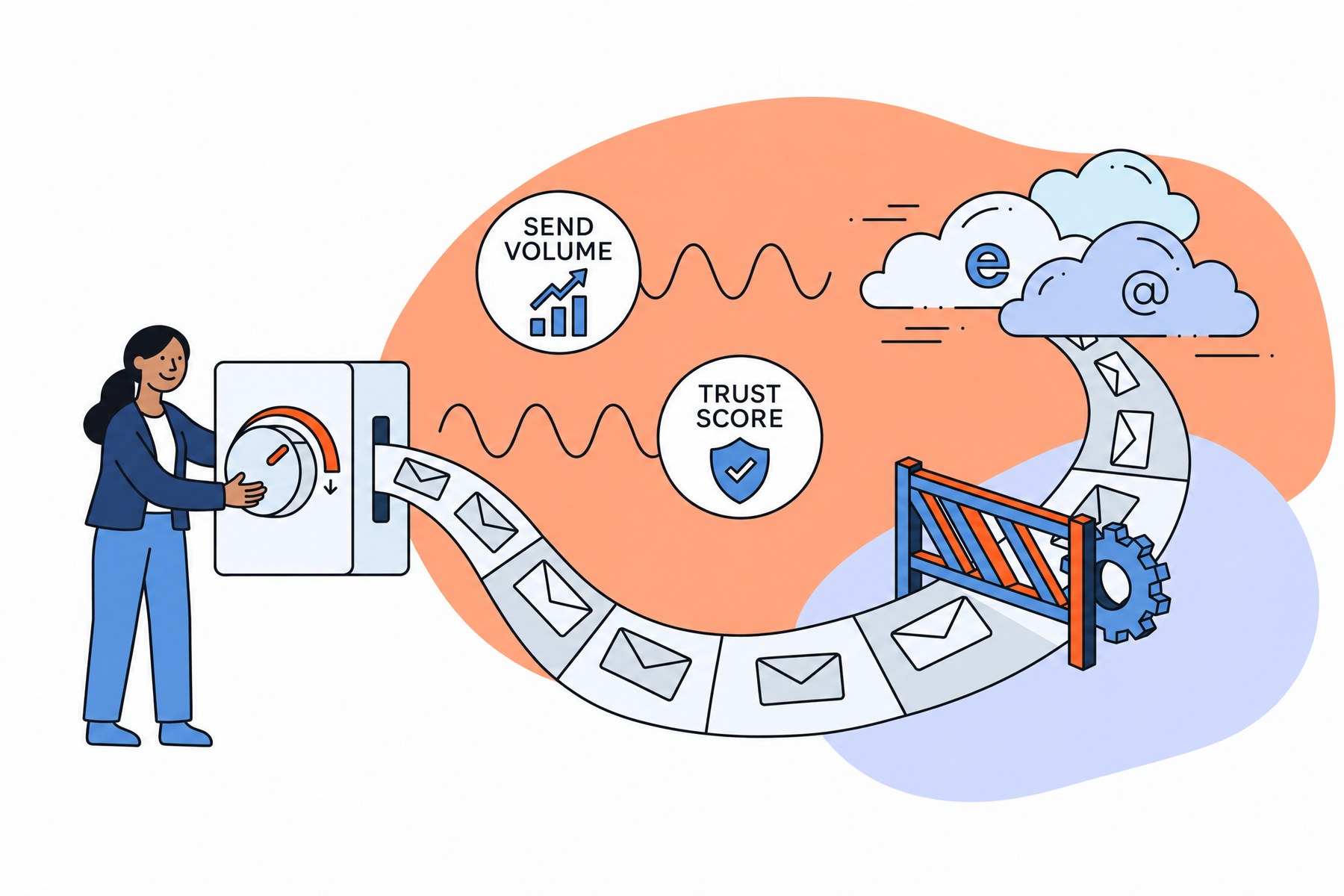
Warming is the process of building trust with mailbox providers — Gmail, Yahoo, Outlook — before you ask them to accept your full sending volume. Get it right and you set a foundation that pays back for years. Get it wrong and you can spend months digging out of a reputation hole.
Here's how to do it properly in HubSpot.
First: are you warming a domain, or an IP? They are not the same thing
This is the distinction almost everyone gets wrong, and it determines whether you need to do any manual work at all. If the difference isn't obvious, here's the plain-English version.
Your domain is who you are. It's the bit after the @ in your from address — brand.com, or a subdomain like news.brand.com. It's the name on the envelope. Mailbox providers build a reputation against it, and that reputation follows you no matter which platform you send from. If you move from Mailchimp to HubSpot, your domain comes with you.
Your IP address is where the mail was posted from. It's the numeric address of the server that physically hands your email to Gmail. Providers build a separate reputation against that, because a server sending junk is a signal regardless of whose name is on it.
The two reputations are assessed independently, which is why you can have a spotless domain and still land in spam if you're sending from a bad IP — and vice versa.
By default, HubSpot puts you on a shared IP: a pool of servers used by many HubSpot customers at once, with the aggregate reputation managed by HubSpot's deliverability team. You benefit from the pool's collective good behaviour, and you carry a small amount of risk from a badly behaved neighbour. A dedicated IP is a paid add-on that gives you an IP nobody else sends from. Full control, and full responsibility — it only makes sense for high-volume senders who mail consistently, because providers need regular traffic to form a judgement. Send sporadically from a dedicated IP and you'll do worse than you would have on the shared pool.
So: a new HubSpot customer on a shared IP has no IP warming to do, because that IP is already warm. What they may well have is a domain that's new to sending, or newly sending through HubSpot — and that does need warming. Which brings us to the two cases.
If you're on a dedicated IP, HubSpot warms it for you. Once you've purchased the Dedicated IP Add-On, completed your DNS records and sent your first marketing email, HubSpot kicks off an automated warm-up that incrementally shifts your traffic from its shared IP pool onto your new dedicated IP. The process takes 40 days. You do not throttle it manually, and trying to second-guess it isn't productive.
If you're warming a domain, the work is yours. A new sending subdomain — or an existing domain that has just moved from Mailchimp, Klaviyo or Salesforce Marketing Cloud into HubSpot — has no established history with mailbox providers on this new sending path. HubSpot's own guidance is explicit: transition volume from your old domain to your new one slowly, and start by contacting only your most highly engaged contacts.
In practice, most of our clients are warming a domain on a shared IP — and for anyone not sending consistent high volume, that's exactly the right setup.
Step 1: Fix the technical foundation before you send anything
Warming a domain that isn't authenticated is pouring water into a bucket with a hole in it.
Get SPF, DKIM and DMARC configured and verified in HubSpot before your first send. This is no longer a nice-to-have. Google and Yahoo began enforcing shared bulk sender requirements in February 2024, with Microsoft following in 2025. For anyone sending roughly 5,000 or more messages a day to a given provider, the requirements now include SPF, DKIM, DMARC with domain alignment, a valid PTR record, and RFC 8058 one-click unsubscribe headers. The consequence of failing them isn't the spam folder — it's outright rejection at the SMTP level.
Two things worth flagging to clients here:
- Alignment matters, not just presence. If you send from news.brand.com but sign with a vendor domain, you're authenticated but not aligned, and DMARC fails. Check alignment, don't just check that records exist.
- The 5,000/day threshold is per sending domain and, once crossed, is effectively permanent. One large campaign and you are a bulk sender from that point forward. Build for the requirements from day one.
Step 2: Clean the list before you warm — this is where ZeroBounce earns its fee
You cannot warm a domain on a dirty list. Bounces and spam-trap hits during warm-up do disproportionate damage, because you have no positive history to offset them.
Run the list through a validation service before the first send. We use ZeroBounce, which has an official HubSpot integration: you connect it from the ZeroBounce Integrations menu, authorise your portal, then select a list — or all lists — to verify. Results sync back into new columns on your HubSpot contact records, so you can build suppression lists off the outcome. You can also set it to re-verify a list on a schedule, and there's a separate forms integration that validates addresses in real time at the point of capture, which stops the problem recurring.
What you're removing:
- Hard invalids and syntax errors
- Known spam traps and abuse/complainer addresses
- Disposable and role-based addresses
- Catch-all domains, or at least flagging them for a lower-priority batch
Alongside validation, apply engagement-based suppression. Anyone who hasn't opened or clicked in 12 months does not belong anywhere near a warm-up. HubSpot's graymail suppression will filter some of this automatically, but do it deliberately with an active list rather than relying on the default.
Step 3: Build your warm-up cohorts
Segment your database by recency of engagement — this is your ramp order:
| Cohort | Definition | When They Enter the Ramp |
|---|---|---|
| Tier 1 | Opened or clicked in last 30 days | Week 1 |
| Tier 2 | Opened or clicked in last 90 days | Week 2–3 |
| Tier 3 | Opened or clicked in last 6 months | Week 3–4 |
| Tier 4 | Engaged in last 12 months | Week 5+ |
| Suppressed | No engagement 12+ months, or failed validation | Not during warm-up |
Build these as active lists in HubSpot so they self-maintain as engagement data updates, rather than static lists that go stale mid-ramp.
Step 4: The ramp itself
There's no single official schedule — mailbox providers don't publish one, and anyone presenting a rigid day-by-day calendar as gospel is guessing. What deliverability practitioners consistently agree on is the shape: start small with your best contacts, increase gradually, and never spike.
A reasonable starting point for a mid-sized list:
- Days 1–3: ~100 sends per day, Tier 1 only
- Days 4–7: roughly double every second day, still Tier 1
- Week 2: introduce Tier 2, continuing to increase in steps of no more than 50–100% per send
- Weeks 3–4: introduce Tier 3, approaching normal volume
- Weeks 5–8: full volume across your cleaned list
Plan for four to eight weeks end to end, scaled to your list size. A common rule of thumb is to open with 1–2% of your total list size, so a 50,000-contact database starts at 500–1,000 rather than 100.
Two rules that matter more than the exact numbers:
- Consistency beats volume. A steady daily or every-other-day cadence builds reputation faster than sporadic large sends.
- Never make up ground. If you fall behind schedule, resume where you are — don't compensate with a double-size send. A single spike can undo weeks of progress.
Step 5: Actually executing the ramp in HubSpot
Historically this was the painful part. HubSpot had no native way to slow a send down, so agencies either split lists into chunks and cloned the email repeatedly, or bought Seventh Sense.
That's changed. Marketing email send throttling is now available in public beta for Marketing Hub Professional and Enterprise, with send rates as low as 1 email per minute distributed across a window of up to 10 days. You'll find it under Advanced Settings in the scheduling panel when you schedule a regular marketing email — it doesn't apply to automated or blog/RSS emails, and it's opt-in per send. If you don't enable it, HubSpot sends as fast as it can.
For lists that still need manual splitting, HubSpot's list sampling feature makes creating randomised chunks less tedious than exporting to Excel.
Step 6: Monitor the right numbers, daily
Warming without measurement is just hoping. Watch these from the first send:
- Spam complaint rate. The hard ceiling is 0.3%; Google's guidance is to stay below 0.1% and never approach 0.3%. At low volume it takes very few complaints to breach this — 30 complaints on a 10,000 send is already at the threshold.
- Bounce rate. Should sit comfortably under 1%. If it doesn't, your validation step failed and you should stop and re-clean rather than push on.
- Open and click rate. These should be higher than your normal baseline during weeks 1–2, because you're mailing your best contacts. If they aren't, something is wrong with placement.
- HubSpot's deliverability health dashboard, plus Google Postmaster Tools and Yahoo's Complaint Feedback Loop. Postmaster is where you'll see your spam rate as Gmail actually measures it, which is the number that counts. Note that HubSpot doesn't integrate with Postmaster directly — set it up separately.
If complaints climb or engagement drops, pause and hold volume at the last stable level for several sends before increasing again. Reversing is always cheaper than recovering.
Step 7: Don't stop when the ramp ends
Sender reputation is a rolling assessment, not a badge you earn once. Keep validation running on a schedule, keep suppressing unengaged contacts, keep sending consistently rather than in bursts, and keep an eye on the deliverability dashboard.
The clients who have deliverability problems two years into HubSpot are almost never the ones who warmed badly. They're the ones who warmed properly, then let list hygiene lapse.
The short version
- Dedicated IP warm-up is automated by HubSpot over 40 days. Domain warming is manual and it's on you.
- Authenticate first. SPF, DKIM, DMARC, alignment, one-click unsubscribe — these are entry requirements now, not best practice.
- Validate the list with something like ZeroBounce before the first send, then keep validating.
- Ramp from your most engaged contacts outward over 4–8 weeks. Consistency over volume. Never spike.
- Use HubSpot's native throttling beta rather than splitting lists by hand.
- Monitor complaint rate above all else. Below 0.1%, never near 0.3%.
Warming isn't complicated. It's just slow, and slow is the point.

.svg)
.webp)